Showing posts with label Queen Victoria. Show all posts

Saturday, September 27, 2014

Victorian Christmas Traditions


The Victorian Roots of Our Modern Christmas


help

Many yearn for an old fashioned Christmas enjoyed by our ancestors. the problem is the old fashioned Christmas was just a marketing ploy to appeal to a growing Victorian middle class
Christmas was generally a family feast in well to do households in the early 19th century household. if their Church affiliaton approved.
Source: Public Domain by Charles Green
text

The Not So Deep Roots of Christmas Present

The modern holiday of Christmas the modern holiday of Christmas as celebrated in the Western world, has its roots in the Victorian era. Both the he British and American public; took traditions from other northern European cultures and created the modern Christmas. This is a look at some of the development of these new holiday traditions.


photo
The English embraced the German tradtion of Christmas trees in 1851.
Source: Public Domaint

Oh Christmas Tree!

The Germans were responsible for giving us the Christmas tree. Many pagan civilizations have used evergreens as a symbol of life during the dead months of winter. We have the Royal family of Queen Victoria to thank for making Christmas trees wildly popular in the US and Britain. Prince Albert in 1841 introduced the idea of a Christmas tree or Tannenbaum. In 1850 an etching of a Christmas tree at Windsor Castle was published. every well to do Victorian home decided that they too should have a Christmas tree. A tradition kept by German immigrants in the past, the Christmas tree soon was fashionable in America too. In America soon, it was popular to decorate your tree with handmade cornucopias filled with nuts, dried fruits, and candies.


photo
Source: Publcic Domain
Traditional Gift Giving taught by The Three Wise Men in the Macy's Window!
In 1870 in America and Britain Christmas trees were so popular; that commercial ornaments were first made. These included molded wax figures of angels, gold paper, and balls decorated with powdered glass Americans further commercialized the new holiday, by taking the tradition of homemade family gift exchange to a new level. Nn the 1880s Macy’s department store started to feature Christmas windows with toys from around the world.. They enticed shoppers into the store, with indows that featured whimsical mechanical decorations.

photo
Victorian protrayal of colonial carolers who just happen to have printed sheet music.
Source: Public Domaint

Now We Can All Sing and Play Jingle Bells

Caroling was originally a way for clever entrepreneurs to take advantage of the presence of pianos in well-to-do Victorian house households.Carolers performed in groups of three. A caroler might play violin, while another sang.A third would sell the sheet music to the popular holiday tune.. Carolers with less commercial goals might sing for neighbors in hopes of being invited in for hot cider and holiday sweets.


Source: Christmas Card 1885

The First Hallmark Moments

Christmas letters to friends and family, where the norm for holiday communication in most Victorian households. Soon the idea of sending Christmas greetings on printed cards are became popular. Early Christmas cards depicted acts of charitable giving, and family celebrations. Many cards tried to portray Christmas as a long held and old fashioned holiday
Market To Market!
This was all part of the marketing of a new holiday, that required consumers to purchase ornaments, store-bought gifts, and of course Christmas cards. It became increasingly popular, to focus on children . This was the reason the Victorians could really take to the holiday. The concept of a happy and somewhat carefree childhood was a growing reality for the middle class in many countries. This was a concept that was non exsistence a few generations before. Children were just adult capable of doing less productive work.
Taking the cue from many northern Europeans, ideas about elves bringing Christmas goodies to children, the tradition of Father Christmas and Santa Claus became wildly popular. Toy makers everywhere knew they would soon have an outlet, by which to guilt parents into purchasing factory produced toys, instead of the handmade standbys.
Santa was not always pictured in red and white until Coke Cola advertising made the red and white Santa clothing standard.
Source: Public Domain

Was Christ Ever The Reason for the Season!
Americans on the whole had had a historic love-hate relationship with Christmas. Many Protestant Americans considered the pagan roots of many of the trappings of Christmas, and rejected it as a proper Christian holiday.-Christmas in the New England colonies was actually being banned. Christmas in the Cavalier colonies was associated with body drunkenness and a work stoppage. Churches struggled to keep the religious and moral significance of the holiday. Charles Dickens, story the Christmas Carol helped reestablish the myth of Christmas being a time of family emphasis and helping. Soon Christmas was being this started nostalgically remembered as a time for family gathering and community concern for the hungry. While, there was not an established tradition of this, churches could encourage the celebration of Christmas with of some moral underpinning.

Attempts to put the Christ back in our modern Christians Christmas are based on the false notion that there was a time when all the trappings of the holidays, had more spiritual meaning. Since most of the popular traditions of Christmas developed from pagan roots, this isan impossibility. Victorian myths of magical Christmas charity overcoming the Scrooges of the world is not a bad idea . It allows all people to enjoy and give during this fairly new holiday season. A true old-fashioned Christmas, it might just have included a day of work followed by a Sunday sermon, on the starkness of Christ birth in a manger. We can all be glad that the Victorians claimed Christmas as a fun children’s holiday that reminds adults of the joy of childhood.


Make Your Own Victorian Ornaments


By the early 20th century children and toys were the main focus of the holiday.

A couple could only kiss if there was berries on the mistletoe,
Source: Public Domain

The Greening of Christmas: Making Our Pagen Ancestors Proud!

Ivy greenery, mistletoe, and holly all have their roots in pagan practices honoring the winter solstice. The Victorians wanting Christmas, to be a special time even for young adults, made up the concept of kissing under the mistletoe. If a supposedly, unlucky couple found themselves under the mistletoe, powers that be insisted they kiss. The number of couples who could kiss under the mistletoe was determined by the number of berries on the mistletoe. One kiss and one berryremoved. No more berries, then there were no more kissing games. I am sure most households, tried to have mistletoe with many berries.


Wednesday, July 23, 2014

Death In The American Victorian Household Part 2


It was common for middle class Victorian men to be displayed in the black suits which they wore for Church or special occasions. It would not be uncommon for a deceased middle class housewife to be displayed in the morning clothes of widows weed and crepe that she wore in life to mourn the passing of her relations. Younger women tended to be displayed in white. It was acceptable to bury children in the best clothes they had and with flowers in their hands.


Funeral Flowers In Parlor: Public Domain


Victorian church women many times urged the wealthier to donate funeral coats to poor families burying children as not to deprive a living child of a needed coat. It seems strange to us a new coat would be given to a living child while a living child was given the coat of a dead child. This did not seem strange to a poor Victorian mother, because she expected to lose at least one child and it was expected she honor the dead child or be accused of being heartless. Many poor families saved for the funeral expenses of their children, at the expense of the quality of life all the household.

Very poor grieving women who had lost a child or provider had to suffer the additional indignity of begging among her neighbors, relatives, and church for the funds to provide a modest funeral for her loved one. Certainly, even the poorest head on household was seen as a poor father and husband if he had not prepared for death that would inevitably visit his household. Trade organizations, ethnic groups, and discreet church funds saved many a poor or working class family from the public humiliation of having to beg for funds to take care of their dead (Hellish, 2010).


Wakes were held in Victorian homes in order to make sure that the deceased was truly dead and would not 'wake' from coma. A relative was posted at the side of the casket. Wakes as social events could last up to four days and the family was relieved of doing the chores of daily life and the preparation of food by friends and neighbors. All blood relations and those related by marriage were expected to show their respect by wearing various degrees of mourning garb.


In general the more closely related a person was who had passed the greater degree of public mourning was expected. Women were in general expected to mourn longer and go to greater means to dress the part. Generally, Aunts, uncles and cousins were expected to wear a degree of mourning garb publically for at least. Relations in other towns that could not attend the funeral were also expected to make a public display of mourning (Levins, 2005)

.


Funeral Photography: The girl is deceased in this photo

A widower was expected to remove himself from public life for a matter on months and in general could get away with wearing mourning armbands. The garb of the middle class husband was normally black anyway and his need to conduct business made his seclusion was public life impractical (Hellish, 2010).

Men were expected to mourn the passing of their wives for at least a year. If the need to have a household kept or presence of small children made his quick remarriage a necessity, the new wife was expected to show deep mourning for the deceased wife for the first at least a year. The reentrance of the family as a whole into social circles was kept for nearly two years an an elaborate system of leaving calling cards was instituted to make sure the surviving household members did not appear frivolous (Hellish, 2010.


Things like attending the theater, parties other than weddings and baptism, and gardening clubs were off limits to all adult household members for a year. Older widows and widower may have been excused from social niceties till the time of their death. Many older women simply never shed the last of the mourning garb, but it is unlikely any kept 'full 'morning garb. Many doctors urged melodramatic Victorian widows to put aside long periods of morning garb where they wore crepe or long veils as it was believed it caused respiratory and vision problems. Very wealthy families decked out their servants in mourning wear they were expected to wear as long as the family 'socially' mourning (Rothman, 2005)

.

There were various practices for mourning periods for children. Mothers were expected to show public displays of mourning for the loss of a child for at least a year. Fathers tended to observe the mourning period according to religious or community practice. Even middle class families were hard pressed to come up expensive clothing and mourning adornments for the loss of a child. It was very common for household to lose many children and to have births in households, that Widow's weeds, veils of crepe, and other elaborate accessories were not practical. Many a resourceful housewife would simply dye the family's wardrobe in black; unfortunately, this black dye often came off on the skin of the mourner (Levins, 2005)

.

Experts in child rearing at the time urged middle class and upper class families to not rear their children to be in a constant dark mood, by easing the degree of mourning that the young needed to display publicly. It was considered emotionally unhealthy to keep the young in a household in black or away from social activities.


Certainly in poor urban families where children worked in factories and on farms it would have been impossible for families to afford any garb apart from that they wore day to day (Hellish, 2010.

Victorian mourning in an average Midwestern farming community would have differed greatly from that that occurred in the middle class or upper class urban home. The showing of the dead would occur in the parlor and not an ornate funeral chapel.


There would be no elaborate parade of black carriages pulled by horses wearing black plumes. A trip for a funeral in the local church and burial in the church graveyard was the norm. Social displays of mourning would be limited to church gatherings or a disruption in business for a merchant in small farm town. Elaborate obituary with flowery Victorian language would appear for the most common citizen in local paper (Rothman, 2005).

When photography became more common and affordable after the civil war, death photography was all the rage with good artist being able to make the deceased appeared lifelike. Decomposition occurred quickly as most people did not have bodies embalmed until after the turn of the century. The deceased may also have looked grotesques after an accident or long illness, but Victorian photographers were not above painting on eyes or adding color to the picture of the dearly departed. Even the poorest families found the money to take pictures of children who passed because many times there were no pictures of the child in life. These pictures are still strangely endearing today (Levins, 2005)

.

Lastly, superstitions may have played a role at side of the deceased in the most common Victorian home. Bodies were carried out feet first to keep the deceased spirit from looking back and taking another family member with them. Mirrors were covered with black crepe and pictures placed face down to keep the deceased from entering the reflection of the living or to keep their spirit from wanting to stay in the home among loved ones (Hellish, 2010)

Saturday, July 19, 2014

Victorian Weddings

public domain

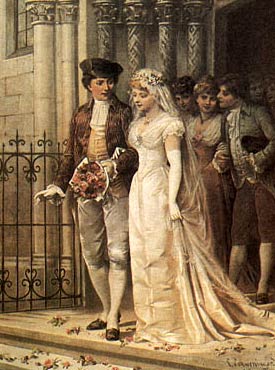
The Victorian wedding was a grand affair. It was a chance to show the world how lavish and respectable your family was in society. The Victorian Wedding was a very sentimental affair with every detail and practice symbolic. The flowers, the cutting of the wedding cake, even the ribbon streamers over the bridal table were weighted with symbolism. Marriages during this time were mostly to secure business deals, increase wealth or raise status for the family
The Victorian engagement ring dates from 1832-1900. These engagement rings are set on yellow or rose gold color. The Victorian engagement rings (1835-1900) had very complex designs with many rows of diamonds and pearls often set in yellow or rose gold.
Queen Victoria herself chose an engagement ring that was in the design of a gold snake, coiling around itself; and ancient Roman symbol denoting eternal love. Half hoop rings with different stones set in were extremely popular, together with the cluster style and various other, generally quite delicate designs. Queen Victoria herself chose an engagement ring that was in the design of a gold snake, coiling around itself an ancient Roman symbol denoting eternal love. Half hoop rings with different stones set in were extremely popular, together with the cluster style and various other, generally quite delicate designs.
The Victorian wedding dress was made of different fabrics like tulle, lace, organdy, and gauze, silk, linen, or even cashmere. The veil was mandatory and it was usually made of super-fine gauze, pure cotton, teamed with lace. Veils were attached to a coronet of flowers, usually orange blossoms for the bride and roses or other in-season flowers for the attendants.
The bride's accessories included: short white kid gloves, hanky emb
English: Queen Victoria and Prince Albert, Buc...
English: Queen Victoria and Prince Albert, Buckingham Palace, 11 May 1854 (after a Drawing Room) (Photo credit: Wikipedia)
roidered with her maiden name initials, silk stockings embroidered up the front, and flat shoes decorated with bows or ribbons at the instep. Veils were attached to a crown or garland of flowers, usually using orange blossoms for the bride and roses or other in-season flowers for the attendants. The bride's outfit would not have been considered correct at all without short white kid gloves, long enough to tuck under the sleeves, with a slit in one finger to slip the ring on without removing the glove
Bridesmaids covered their heads with short white veils. Weddings at home did not require a veil; headpieces of flowers and ribbons were worn. Bridesmaids stood to the left and right of the couple, while ushers help guide the guests. Etiquette dictated that guests address the bride first, unless they were only acquainted with the groom, in which case they congratulated the groom and were then introduced to the bride.
Popular conceptions of the Victorian wedding night and honeymoon frequently turn on assumptions about sexual ignorance and its conversion to sudden, terrible knowledge. One widely circulated story of John Ruskin's ill-fated wedding night, for example, is that he was so unfamiliar with the ordinary adult female body that he was shocked to find his wife not quite as smooth and hairless as the classical statuary in museums.
English: Bride and bridesmaids, 1900-1910 A st...
English: Bride and bridesmaids, 1900-1910 A studio portrait of a bride and three bridesmaids. The bride wears a high necked dress and a veil with headpiece. The bridesmaids wear matching dresses with full sleeves gathered at the top and with ruffles at the hem. Shaefer & Deazley, Austral Studio, Toowoomba. (Photo credit: Wikipedia)